
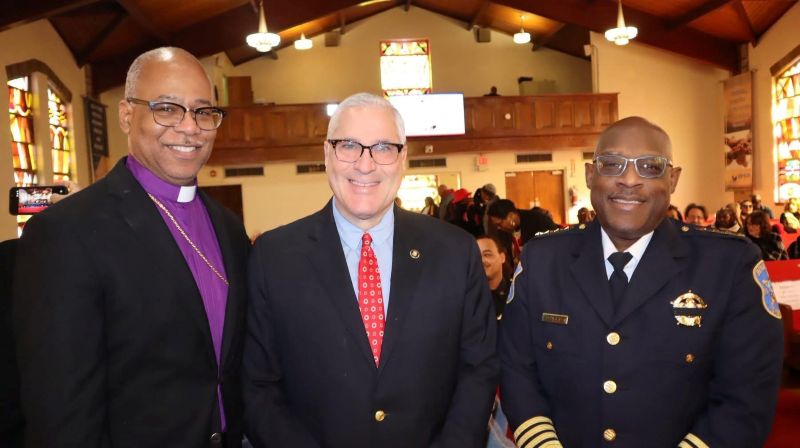
As we honor the life, legacy, and enduring moral leadership of Dr. Martin Luther King Jr. I thank the Pastor and Congregation of Englewood’s historic Ebenezer Baptist Church for hosting us, along with all those who contribute to making this such a meaningful annual gathering for our community.
Dr. King was not only a leader of a movement; he was a steward of conscience for our nation. His words and actions challenged America to live up to its highest ideals—to ensure that liberty and justice are not merely aspirations written on paper, but realities experienced in everyday life by every person, in every community.
Today is not simply a day of remembrance. It is a day of reflection, and more importantly, a day of responsibility. As we celebrate the life of Dr. King, we don’t have to look toward Montgomery or Selma to see the spirit of the movement. We only must look at the streets where we stand.
Dr. King reminded us that “the arc of the moral universe is long, but it bends toward justice.” That arc does not bend on its own. It bends because ordinary people—teachers, students, public servants, faith leaders, volunteers, and neighbors—commit themselves to fairness, dignity, and mutual respect. It bends because communities like Englewood choose to act.
Englewood is often called the “City of Trees,” but those of us who live here know it is also a city of roots. We are a community built on deep foundations of faith, activism, and a beautiful, complex diversity that mirrors the very dream Dr. King dedicated his life to.
We remember that in 1962, our own City Hall became a battleground for equality. We honor the “Englewood Eleven”—those brave residents, who staged an all-night sit-in in the council chambers to protest school segregation. They didn’t just talk about justice; they slept on the floor for it, and several were arrested for their stance. We remember the families of the Lincoln School, who marched and boycotted to ensure that every child in Englewood—regardless of the color of their skin—had access to the same high-quality education.
Our city has a storied history of Civil Rights leadership and civic engagement that illustrates Dr. King’s call to action, including local legends such as:
- Arnold Brown, born right here in Englewood, became the first African-American elected to represent Bergen County in the New Jersey Legislature. His service in the Assembly helped shape a more inclusive political landscape for all in our region and his contributions in documenting our local history give us irreplaceable context to view our growth.
- John T. Wright, who was raised in Englewood and later served on our City Council, broke barriers as the first Black councilmember in Bergen County, helping open doors for future generations.
- Several members of the famed Tuskegee Airmen, like the late Calvin Spann and Bravell Nesbitt, lived among us and reminded us that the fight for freedom abroad is hollow without the fight for dignity at home, risking life and limb overseas only to return to continued discrimination and injustice.
- Sister Souljah, who came to Englewood as a child, attended Dwight Morrow High School, and went on to be a powerful voice for artistic heritage, social justice and community empowerment.
- Jack Drakeford, our city’s first Black City Manager and a dear friend, whose leadership paved the way for so many of us, and whose lessons continue to guide my own course and that of many others to this day.
These are just a few of the individuals whose lives demonstrate the strength, resilience, and leadership that Dr. King envisioned for all communities.
In the same essence, Englewood’s faith communities and houses of worship have served not only as places of spiritual grounding, but also as hubs of community support and civic engagement.
Marching to Ebenezer Baptist on this day each year, it is one piece of a critical network within our community which has been central to providing for the needs of our families and neighbors. They provide not only spiritual guidance, but also education, food, shelter, advocacy, and hope – all necessities of the lives our residents deserve. These institutions remind us that faith, when lived fully, demands practical expressions of faith in action.
These historic congregations reflect our community’s spiritual diversity and its shared commitment to service, compassion, and justice.
We are also fortunate to have several community organizations whose civic engagement and advocacy align with Dr. King’s vision and likewise uplift our city. The efforts of our NAACP, Jabari Society, Historical Society, Remember the 400, and so many others allow us to strengthen civic participation by preserving the narratives that shape our collective understanding, elevate the stories and heritage of African Americans in our region, and ensure that our history informs and motivates our future work together.
Englewood’s diversity—composed of varied backgrounds, cultures, and beliefs—is not simply a demographic fact. It is our strength. It is tangible evidence that the beloved community envisioned by Dr. King is achievable here, not as an abstract ideal, but as lived reality.
As your Mayor, I am humbled by the spirit of service I see in this city every day. I see it in our educators who prepare the next generation not only for success, but for citizenship. I see it in our community organizations that address hunger, housing, and health. I see it in our first responders, municipal employees, and volunteers who serve this city with professionalism and compassion.
While we celebrate this holiday each year, it should not be treated as a day “off”. It is a day “on”–to measure the distance between the world as it is and the world as Dr. King envisioned it. Dr. King famously reminded us that “Injustice anywhere is a threat to justice everywhere.”
As a former federal prosecutor and as an immigration attorney who fights daily for the rights of those seeking a better life on our shores, I know that justice is not a static state. It is a constant pursuit. It requires us to look at our own streets, our own schools, and our own hearts.
The state of civil rights in America today is complex. We have made undeniable progress since Dr. King’s time—progress in law, in representation, and in consciousness of our circumstances. Doors once firmly closed have been opened, and opportunities once denied are now more widely available. Yet Dr. King warned us against complacency. And he would remind us today that progress does not mean completion.
Across our nation, we continue to grapple with issues of unequal opportunity, economic disparity, access to quality education, voting rights, housing fairness, and justice within our institutions. Too many Americans still experience discrimination—sometimes subtle, sometimes overt—based on race, religion, background, or belief. Too often, division and rhetoric replace dialogue and understanding.
While these struggles are not identical, they are deeply connected. Dr. King understood this connection. He believed that the fight for civil rights must be broad, inclusive, and rooted in the recognition of our shared humanity.
Civil rights are not a zero-sum proposition. Advancing equality for one group does not diminish another. On the contrary, when we expand rights, we strengthen democracy itself.
The African-American civil rights movement paved the way for broader protections and expanded freedoms, inspiring movements for immigrant rights, LGBTQ+ equality, women’s rights, and disability rights. Each of these struggles draws from the same moral foundation: the belief that no one should be denied opportunity, safety, or dignity because of who they are, where they come from, whom they love, or how they worship.
Dr. King taught us that justice cannot be selective, and equality cannot be conditional. Civil rights are not a chapter of history to be closed; they are a living commitment that must be renewed by each generation. We live in a time where the “fierce urgency of now” is louder than ever. We see divides in our nation that seek to pull us apart. But here in Englewood, we choose a different path. We choose the path where we don’t just tolerate our differences, but we lean on them as our greatest source of strength.
Dr. King once said, “Life’s most persistent and urgent question is: What are you doing for others?” On this day, may that question guide us—not just today, but throughout the year ahead, and beyond. To our youth: you are the architects of the next chapter. Don’t wait for permission to lead. To our neighbors: reach across the aisle, across the ward lines, and across the dinner table. To our leaders: let us ensure that our policies reflect our values—that housing, education, healthcare, and safety are rights, not privileges.
Let us recommit today to those values that Dr. King held sacred: equality under the law, respect for human dignity, and nonviolence in both word and deed. Let us teach our children not only the history of the civil rights movement, but the responsibility they inherit as its heirs. And let us ensure that Englewood remains a place where every resident feels seen, valued, and empowered.
Thank you. May God bless you, and may God bless the City of Englewood.