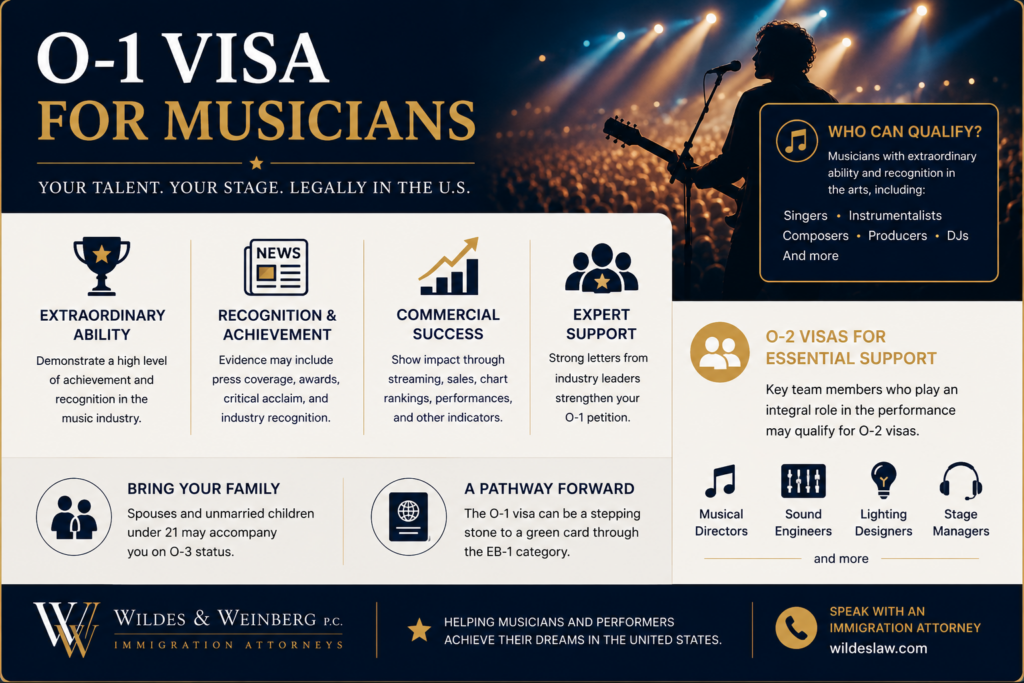
For talented musicians seeking to perform, record, tour, or build their careers in the United States, the O-1 visa can be one of the most powerful immigration options available. Designed for individuals with extraordinary ability in their field, the O-1 visa allows internationally recognized artists and performers to work in the United States and pursue professional opportunities at the highest levels of their fields.
Whether you are a recording artist, composer, producer, conductor, DJ, instrumentalist, vocalist, or member of a touring act, understanding the O-1 visa process is essential to determining whether this pathway may be right for you.
What Is an O-1 Visa?
The O-1 visa is a non-immigrant visa classification intended only for those who have exhibited extraordinary abilities in the scientific, artistic, educational, business, or athletic fields, or in the motion picture and television industries.
In the context of musicians and other artists, the O-1 Visa refers to the O-1B visa. In order to qualify for such a visa, one should prove his or her distinction in the field of arts, which implies a high level of achievements demonstrated by extraordinary skill and recognition substantially beyond that ordinarily encountered in the field.
It is a myth that an artist has to be famous to qualify for such a visa. There are many cases when people are qualified because they have already established themselves as leaders in a specific genre or market.
Who Can Qualify?
The O-1 visa is available to a wide range of music professionals, including:
- Recording artists
- Singers and vocalists
- Songwriters
- Composers
- Conductors
- Music producers
- Disc Jockeys & Electronic Music Producers
- Instrumental Musicians
- Traveling Musicians
- Internationally Known Band Members
- Accomplished Session Musicians
Each application is evaluated on its own merit based on the credentials of the individual applying.
How Do Musicians Prove Their Extraordinary Ability?
USCIS judges O-1 petitions against a specific set of criteria. There are several ways to meet them, but for musicians, the evidence tends to fall into a few familiar categories.
Significant Awards and Recognition
Awards earned at the national or international level can show that an artist stands out in the field. These might be industry awards, festival prizes, competition wins, or similar honors.
Press and Media Coverage
Published articles discussing the artist’s work are among the most valuable forms of evidence. Media coverage in reputable publications, newspapers, blogs, magazines, and industry sources would indicate that the musician has received attention from the industry.
Commercial Success
Commercial success could be indicated by:
- Streaming data
- Chart positions on Billboard or similar sources
- Sales figures
- Radio play
- Going viral online
- Concert attendance figures
Leading or Critical Roles
Musicians who have served as lead performers, principal artists, featured soloists, or key contributors to distinguished organizations, productions, or ensembles may demonstrate eligibility through their professional roles.
Distinguished Collaborations
Collaborations with already successful artists, producers, record labels, orchestras, or entertainment corporations will help strengthen one’s O-1 petition, especially if industry professionals recognize them.
Testimonials From Experts
Letters from experts in the music industry are often an important element that demonstrates one’s accomplishments and status in the field.
Common Misconceptions About O-1 Visas for Musicians
“I Need a Grammy to Qualify”
Not so. A major award helps, but plenty of approved applicants qualify through other forms of evidence: press coverage, commercial sales, well-known performances, work with respected collaborators, and recognition from people in the industry. It is the overall picture that counts, not one trophy.
“Only Major Label Artists Qualify”
Independent artists qualify, too. Streaming numbers, a real social media following, self-released records, and digital distribution have given artists outside the label system plenty of ways to show they stand out and to put together a strong O-1 case.
“I Need Decades of Experience”
Tenure in the business is not the deciding factor. A fair number of younger artists have won O-1 approval on the strength of what they accomplished early on.
The Importance of Proper Case Strategy
One of the errors most musicians make is assuming that talent alone will be sufficient. USCIS doesn’t assess one’s artistic skills. Instead, it assesses the evidence that supports those skills.
A good case needs an effective presentation of the evidence that tells the story of the artist professionally. Media coverage, contracts, awards, performances, recommendations, digital streaming records, and other industry recognition collectively support the argument that the individual has distinguished themself in the industry.
For this reason, strategic case preparation is often as important as the underlying achievements themselves.
O-2 Visas for Essential Support Personnel
In addition to the O-1 visa, certain musicians and performers may be accompanied by essential support personnel under the O-2 visa category. An O-2 beneficiary must play an integral role in the O-1 artist’s performance and possess critical skills and experience that are not readily available from a US worker.
In music, the O-2 visa usually covers the people who travel with an artist, such as a musical director, sound engineer, lighting designer, choreographer, or stage manager. What matters for an O-2 is that the person has worked with the artist long enough for the performance to depend on them.
Like the O-1 visa, the O-2 visa is employer-specific and generally tied to the duration of the O-1 artist’s approved engagements in the United States. Proper documentation demonstrating the necessity of the support worker’s services is critical to obtaining O-2 approval.
Can Family Members Accompany an O-1 Musician?
Yes. Spouses and unmarried children under 21 may generally accompany the principal O-1 beneficiary in O-3 status. While O-3 dependents are not authorized to work in the United States, they may reside in the country for the duration of the O-1 holder’s authorized stay.
O-1 Visas as a Pathway to Permanent Residence
For many musicians, the O-1 visa serves as an important stepping stone toward obtaining a green card. Depending on an individual’s accomplishments and long-term goals, options such as the EB-1 Extraordinary Ability category may eventually become available.
Planning may assist artists in acquiring an impressive record of achievements that will make them eligible for permanent residence in the future.
Concluding Remarks
The US still draws many of the world’s best musicians, artists, and performers. For someone who has built a real reputation in their field, the O-1 visa is a practical way to keep working and performing in the States.
No two music careers look the same, so figuring out whether you qualify means looking closely at what you have done, the credentials you hold, and the evidence you can actually put on paper. A lot of musicians find that once their work is planned out and presented well, they make a far stronger O-1 case than they expected.
If you are a musician, performer, producer, or work in music in some other capacity and you are weighing a move to the United States, an experienced immigration attorney can review where you stand and build the strongest case for you.
Questions, or looking for an immigration lawyer for musicians?
Reach out to us at josh@wildeslaw.com.