
Major Development for Employers and Foreign Talent
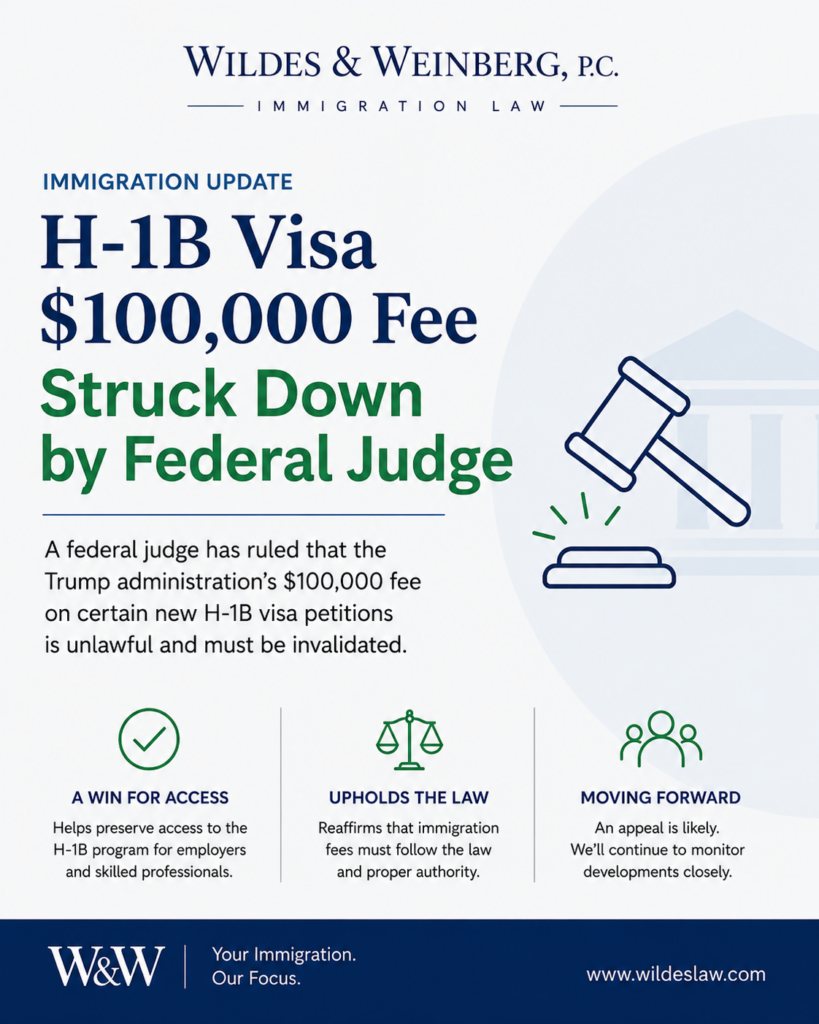
In a significant decision affecting employers, foreign professionals, and the future of employment-based immigration, a federal judge has ruled that the controversial $100,000 fee imposed on certain new H-1B visa petitions is unlawful.
The fee, which was introduced as part of the Trump administration’s broader efforts to reshape legal immigration policy, represented an unprecedented increase in the cost of sponsoring highly skilled foreign workers. Employers across a wide range of industries expressed concern that the fee would make participation in the H-1B program financially impossible for many organizations, particularly startups, universities, healthcare providers, and small-to-medium-sized businesses.
The court determined that the administration exceeded its authority in implementing the fee and ordered that it be invalidated.
Why the Decision Matters
The H-1B visa program has long served as one of the primary pathways for U.S. employers to hire highly skilled foreign professionals in fields such as technology, healthcare, engineering, finance, education, and research.
For many employers, the $100,000 surcharge created substantial uncertainty regarding workforce planning and talent acquisition. Critics argued that the fee effectively functioned as a barrier to participation in the program rather than a legitimate administrative cost.
By striking down the fee, the court has preserved access to an important immigration pathway that many American businesses rely upon to fill specialized positions.
What Happens Next?
Although the ruling represents a significant setback for the policy, the litigation may not be over. The government is expected to consider its appellate options, meaning the issue could continue to be litigated in higher courts.
As with many immigration-related developments, the legal landscape remains fluid. Employers and foreign nationals should continue monitoring updates as additional guidance and court decisions emerge.
The Bigger Picture
Beyond the immediate impact on the H-1B program, the decision highlights an important legal question that has appeared repeatedly in recent years: How much authority does the executive branch have to reshape immigration policy without congressional action?
The answer to that question will continue to influence the future of both employment-based and family-based immigration programs.
At Wildes & Weinberg, P.C., we will continue to monitor developments closely and provide updates on any significant changes affecting employers, foreign workers, and the immigration community.
If you have questions regarding H-1B visas, employment-based immigration strategies, or compliance obligations, our team is available to assist. Contact us now at info@wildeslaw.com.
*Posted on June 8, 2026